


Last Updated: October 28, 2026
Quick Summary
Durable play blankets for rough toddlers have a polyester fleece front, a water-resistant back, and reinforced seams and corners that hold up to pulling and daily washing. Choose a foam mat for cushioning on hard floors and a play blanket for portability, draping, and outdoor use.
- Materials and stitching matter more than thickness alone when judging durability.
- Blot spills immediately with a dry cloth, pressing rather than rubbing to avoid pushing liquid deeper.
- Avoid harsh detergents, bleach, and fabric softeners, which can break down the water-resistant coating.
- Always dry the blanket fully opened and never store it damp to prevent odor.
- If water soaks into the back instead of beading, the coating is failing and the blanket may need replacing.
Table of Contents
- Why Rough Toddler Play Is Hard on Blankets
- What Makes a Play Blanket Durable Enough for Toddlers
- Play Blanket Versus Foam Mat: Which Holds Up Better
- Non-Slip Play Mat for Toddlers: Does a Blanket Stay Put?
- Washable Play Blanket for Kids: Cleaning and Spill Handling
- Indoor Fort Blanket for Kids and Wear Over Time
- Choosing Your BlanketPals Picnic Blanket for Rough Play
- Frequently Asked Questions
Why Rough Toddler Play Is Hard on Blankets
Toddlers test everything they own, and play blankets get the hardest treatment of all: dragged across hardwood, folded into tunnels, pulled by the corners and sat on for hours. This guide explains what to look for before you buy.
What Makes a Play Blanket Durable Enough for Toddlers
A durable play blanket holds up to pulling, folding and daily washing without losing shape or coming apart at the edges. Materials and stitching matter more than thickness alone.
Fleece Front and Water-Resistant Back
Our Picnic BlanketPal™ designs use a 100% polyester fleece front with a 100% deep water-resistant back.
Seams, Edges, and Folding Stress
Folding is the other stress point, since repeated creases weaken fibers. Our picnic blankets include a corner fold so the blanket folds the same way each time, reducing strain on the same spots.
Play Blanket Versus Foam Mat: Which Holds Up Better
A foam mat and a play blanket fail in different ways under rough toddler play, so the better choice depends on which failure modes you can tolerate and where the mat will live. Here's how each resists scratching, tearing, denting, seam separation and repeated impact.
How Each Option Fails Under Rough Play
| Stress Type | Foam Mat Behavior | Play Blanket Behavior |
|---|---|---|
| Scratching (toys, nails) | Surface may scuff or puncture; deep gouges can expose foam core | Fleece face may pill or fuzz; woven fabrics can snag |
| Tearing | Can tear at seams or where foam is thin; punctures from sharp toys | Tears start at seams or loose threads, especially at corners |
| Denting | Foam compresses permanently under heavy furniture or repeated impact | Fabric may crush or mat down but usually recovers after washing |
| Seam separation | Seams can split if stitching is weak or foam core shifts | Edges and corner seams are the first to go; binding can unravel |
| Repeated impact (jumping, falling) | Thick foam absorbs impact well but may bottom out over time | Minimal impact absorption; relies on floor beneath |
Matching the Mat to Your Floor and Play Style
- Hardwood or tile: A foam mat with a non-slip base is the safer choice for crawling and tumbling because it stays put and cushions falls. A blanket alone will slide and offers little impact protection.
- Carpet or low-pile rug: A play blanket with a textured back grips better here, and the carpet provides some cushioning underneath. Foam mats can work but may shift on plush carpet.
- Outdoors or on the go: A play blanket wins on portability and packability. Foam mats are bulky and heavy, and most are not designed for wet grass or uneven ground.
- Fort building and imaginative play: Blankets are the clear choice because they drape and fold. Foam mats are rigid and cannot be draped over chairs.
A Note on Long-Term Wear
Inspect both types regularly. On a foam mat, look for cracks, crumbling edges or compressed areas that no longer spring back. On a play blanket, check seams, binding and corners for loose threads or separation. Foam mats often last two to three years with daily use before the core degrades, while a well-made play blanket may show seam wear within a year if dragged and pulled daily. Match the material to the abuse it will face, and replace it when damage compromises safety or function.
Non-Slip Play Mat for Toddlers: Does a Blanket Stay Put?
If stability matters most, place the blanket on a low-pile rug or a grassy area, or pin the corners with weights during play. Check each listing for backing details before assuming it will grip. We do not claim non-slip performance for our blankets beyond what the product listing states.
Washable Play Blanket for Kids: Cleaning and Spill Handling
"Wipe clean" and "follow the care label" aren't enough when a toddler has just upended a cup of juice. Here's how common messes behave on a fleece-faced, water-resistant-backed play blanket, what reaches the seams and floor, and how to clean without shortening its life.
Picnic BlanketPal™ - with Shark at Coral Bay (2 Family Sizes, $54.95 - $69.95) →
How Common Spills Behave on a Water-Resistant Backed Blanket
- Water and juice: Bead up briefly on the fleece, then wick into the fibers. Blot immediately with a dry cloth or paper towel; most of the liquid can be lifted before it spreads. If left, it will saturate the fleece and sit against the water-resistant backing, which can lead to odor if not dried thoroughly.
- Milk and sugary drinks: These leave a residue that can sour if not rinsed. Blot, then wipe with a damp cloth and a mild detergent solution. Avoid saturating the blanket; use as little water as possible.
- Oily or greasy foods: These are the hardest to remove from fleece because oils bind to polyester fibers. Blot first, then apply a small amount of dish soap diluted in water, work gently into the stain, and rinse by wiping with a clean damp cloth. Repeat if needed.
- Crumbs and solids: Shake out or vacuum the fleece side before wiping. Solids that get pressed into the fleece can be loosened with a soft brush.
What Reaches the Seams and Floor
The water-resistant backing does its job if the spill stays on the fleece. If liquid reaches the edges and wicks through, you may see a damp ring on the floor beneath the seam, a sign to clean and dry more thoroughly and inspect the seam stitching for gaps.
Cleaning Steps That Preserve the Water-Resistant Back
- Shake out loose debris outdoors or over a bin.
- Blot liquids immediately with a dry, absorbent cloth. Press, do not rub, to avoid pushing liquid deeper into the fleece.
- Spot clean with mild soap and a damp cloth for most messes. Avoid harsh detergents, bleach, and fabric softeners, which can break down the water-resistant coating and leave residue that attracts dirt.
- Rinse by wiping with a clean damp cloth rather than soaking the blanket. If the whole blanket needs washing, check the care label first; many fleece-backed blankets can be machine washed on a gentle cycle, but high heat and harsh cycles can damage the backing.
- Air dry by draping the blanket over a clothesline or chair, seam-side up, in a ventilated area. Avoid direct sunlight for extended periods, which can degrade the water-resistant coating. Do not tumble dry on high heat unless the care label explicitly allows it.
- Inspect seams and backing after each wash. If the backing feels sticky, cracked, or no longer repels water, the coating is wearing out.
Odor and Stain Prevention
Fleece can hold odors if liquids sit, most commonly when a spill soaks through the fleece and rests against the water-resistant backing without adequate drying. Always dry the blanket fully opened and never store it damp. For stubborn odors, a diluted white vinegar solution (one part vinegar to three parts water) wiped over the fleece and rinsed can help, but test a small area first. Avoid enzymatic cleaners unless the care label approves them, as they can affect some coatings.
When Cleaning Is Not Enough
If a spill has penetrated the seams and odor lingers after cleaning, or the water-resistant backing no longer repels liquid (sprinkle a few drops on the back, if they soak in rather than bead, the coating is failing), it may be time to replace the blanket. A failing back lets spills reach the floor and inner layers, leading to mold and odor, and no surface cleaning will restore performance.
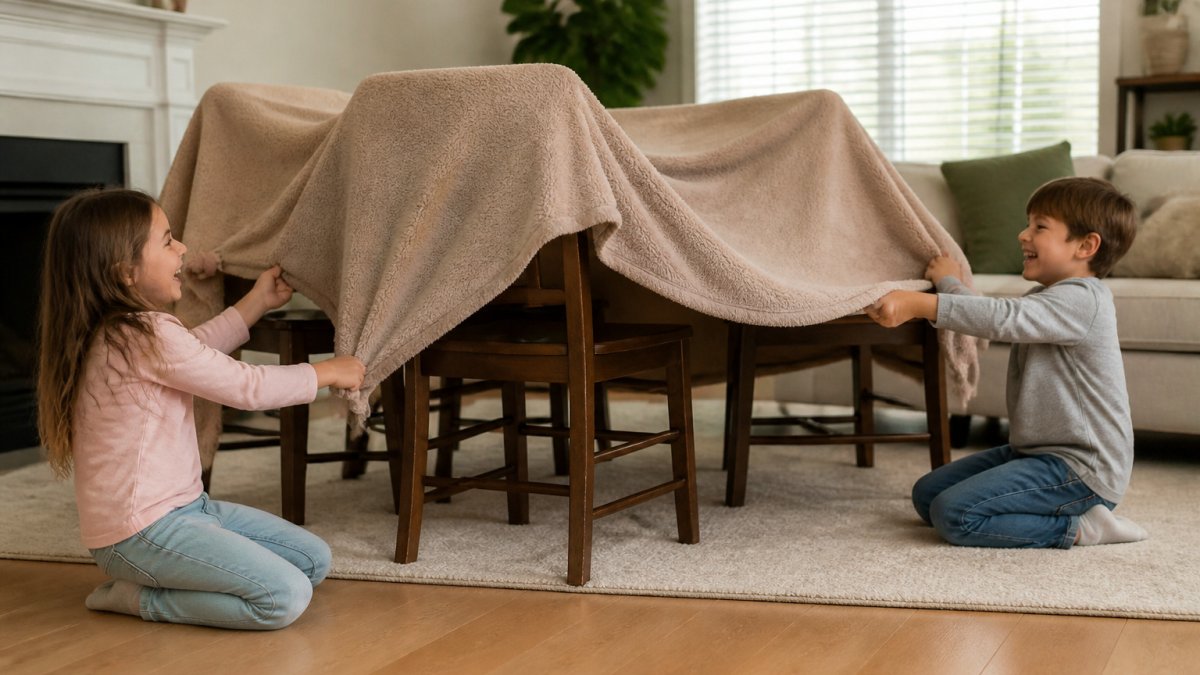
Indoor Fort Blanket for Kids and Wear Over Time
Rotate the blanket between uses, avoid pulling it taut over sharp chair edges, and store it folded loosely rather than crushed into a tight ball. Kids who build forts daily will eventually wear any blanket, so plan on replacing a worn-out one.
Choosing Your BlanketPals Picnic Blanket for Rough Play
Our picnic range includes a fleece face, a water-resistant back and a corner fold. Choose a design and size:
- Picnic BlanketPal™ - with Shark at Coral Bay (2 Family Sizes, $54.95 - $69.95) Water Resistant: A leopard shark and coral design with a 100% polyester fleece front and 100% deep water-resistant back.
- Picnic BlanketPal™ - Outdoor Adventure (2 Family Sizes, $54.95 - $69.95) Water Resistant: A roads, rail and river-crossing print with a buckled carrying strap included, sold in two family sizes.
- Picnic BlanketPal™ - at the Racetrack (2 Family Sizes, $54.95 - $69.95) Water Resistant: A full racetrack print with zig-zag shortcuts, sold in two family sizes.
- Picnic BlanketPal™ - at the Airport (2 Family Sizes, $54.95 - $69.95) Water Resistant: An airport and train-track print, sold in two family sizes.
- Browse the full picnic blanket collection in the 51x61 format: Compare sizes before you decide.
| Design | Sizes | Starting Price | Best For |
|---|---|---|---|
| Shark at Coral Bay | 50 x 60 in, 60 x 80 in | $54.95 | Water play and ocean themes |
| Outdoor Adventure | 50 x 60 in, 60 x 80 in | $54.95 | Road and construction play |
| Racetrack | 50 x 60 in, 60 x 80 in | $54.95 | Car lovers and track play |
| Airport | 50 x 60 in, 60 x 80 in | $54.95 | Travel-themed imaginative play |
The listed family sizes are 50 x 60 and 60 x 80 inches. Check the listing details before you buy.


Last Updated: October 28, 2026
Frequently Asked Questions
What makes a play blanket durable enough for toddlers?
The Picnic BlanketPal™ designs listed here have a 100% polyester fleece front and a 100% deep water-resistant back. The listed family sizes are 50 x 60 and 60 x 80 inches.
Are play blankets safe for active toddlers?
Check the product listing for material details before buying.
How often should you wash a toddler's play blanket?
Wash it whenever it picks up food, drink, or mud, and otherwise at a regular interval such as every few weeks if it is used daily. Follow the care label, since heat and harsh detergents can wear out fleece faster. Spot clean spills right away, because a water-resistant back still needs prompt wiping to keep stains from setting into the fabric. Air dry where possible to preserve the fleece texture.
