


Quick Summary
Screen-free toys for kids hold attention longer because they ask the child to make decisions, move, or invent a story, instead of delivering the next moment on their own. Pick toys by age, favour open-ended designs that can be played with alone, and check age labels and small parts before buying.
- Toddlers need large, sturdy pieces, since anything that fits through a toilet paper roll is a choking hazard under three.
- Ages 4 to 6 benefit from open-ended scenery and figures that support storytelling and early cooperation.
- Test whether your child can start a toy in under a minute without your help; if not, it will likely sit on the shelf.
- Rotating a few toys every couple of weeks keeps the set feeling new without buying more.
Table of Contents
- Why Screen-Free Toys Hold Kids' Attention Longer
- Screen-Free Toys for Toddlers Ages 1 to 3
- Toys That Keep Kids Busy at Home Ages 4 to 10
- Independent Play Toys That Let Kids Start Without You
- Travel Toys for Kids: What Works in the Car and at Restaurants
- How to Judge Safety, Materials and Value Before You Buy
- Choosing Your First Screen-Free Toy This Week
- Frequently Asked Questions
Why Screen-Free Toys Hold Kids' Attention Longer
Screen-free toys for kids keep children engaged because they ask for something in return: a decision, a movement, a story. A screen delivers the next moment for them. A toy waits for the child to make the next move.
At BlanketPals, we design around this idea. Our blankets turn into 3D playscapes that children build and rebuild, so the play stays open-ended instead of ending when the video does.
A common mistake is judging a toy by how exciting it looks in the box. What matters more is whether a child can return to it on day three and find something new. Toys that offer one fixed activity tend to go stale quickly. Toys that support many small story lines last longer.
American Academy of Pediatrics guidance on media and young children
Screen-Free Toys for Toddlers Ages 1 to 3
Toddlers learn through their hands, mouths, and whole bodies. At this age, the best screen-free toys for kids are soft, sturdy, easy to grab, and built around simple cause-and-effect action. The toy should respond to the child, not the other way around.
What to look for at ages 1 to 3:
-
Large pieces only. Anything small enough to fit through a toilet paper roll is a choking hazard for children under three. Check the age label and inspect for loose parts, buttons, or detachable eyes before handing a toy to a toddler.
-
Simple cause-and-effect. A toy that does one clear thing, squeaks, rolls, stacks, nests, teaches the child that their action matters. Toys with too many options at once tend to get batted away.
Age-by-age examples within this range:
- 12 to 18 months: Stacking cups, soft blocks, board books with textures, and large knob puzzles. These support grasping, releasing, and early problem-solving.
- 18 to 24 months: Push-and-pull toys, shape sorters, and simple pretend-play items like a soft doll or a toy phone. These support cause-and-effect and early imitation.
- 24 to 36 months: Chunky crayons, play dough, felt boards, and open-ended scenery like a fold-out play blanket with figures. These support fine motor control and storytelling.
Safety and sensory notes:
- Avoid toys with small magnets or button batteries, both are serious hazards if swallowed.
- For children with sensory sensitivities, choose toys with muted colors, soft textures, and no loud electronic sounds.
- A parent sitting in and joining the game, even briefly, can help toddlers stay engaged. Narrate the action, hand over a car, or move a figure across the blanket.
CDC milestones for early childhood play and development
Here is a quick guide to the age-by-age toy types the article recommends for toddlers.
| Age | Toy types | Skill supported |
|---|---|---|
| 12 to 18 months | Stacking cups, soft blocks, textured board books | Grasping and releasing |
| 18 to 24 months | Push-and-pull toys, shape sorters, soft doll | Cause-and-effect and imitation |
| 24 to 36 months | Chunky crayons, play dough, felt boards | Fine motor control and storytelling |
Toys That Keep Kids Busy at Home Ages 4 to 10
Older children need toys with more depth. For a deeper guide on open-ended toys, see open-ended toys guide. For kids aged 4 to 10, the most useful screen-free toys support building, storytelling, and rules they can invent themselves. The key shift at this age is from cause-and-effect to planning and imagination, the child wants to decide what happens next.
Age-by-age guide:
- Ages 4 to 6: Open-ended scenery and figures for pretend play. Examples include felt boards, play mats with roads and buildings, chunky building blocks, and dress-up clothes. These support storytelling and early cooperation.
- Ages 7 to 8: Sets that reward planning, such as track layouts, marble runs, and simple building kits with instructions. These support sequencing, patience, and spatial reasoning.
- Ages 9 to 10: Projects with a clear goal, like drawing boards, model kits, and more complex building sets. These support sustained attention and a sense of accomplishment.
What keeps kids busy is not the number of pieces. It is whether they can change the rules of play.
Safety and materials for this age range:
-
Check age labels even for older kids, small parts, magnets, and projectiles are still hazards for siblings under three.
-
For children with motor or sensory needs, choose toys with larger pieces, clear instructions, and adjustable difficulty. A toy that can be simplified or extended works for a wider range of abilities.
Low-prep, low-mess options:
- Felt boards and play mats need almost no setup and clean up in seconds.
- Building sets require more setup but can stay out for days if you have a dedicated play space.
- Drawing boards and magnetic tiles offer mess-free creativity with minimal adult help.
Independent Play Toys That Let Kids Start Without You
Independent play is one of the strongest reasons to choose a screen-free toy. For more blanket-based ideas kids can start on their own, browse blanket play ideas that beat screen time. A child who can start a game alone gives a parent time to cook, work, or rest.
Good independent play toys share a few traits: they need little setup, they have a clear starting point, and they can be cleaned up in minutes.
Watch out: a toy that needs constant adult help to start will rarely be used alone. Test whether your child can begin playing without asking you first.
Travel Toys for Kids: What Works in the Car and at Restaurants
Travel is where screen-free toys earn their place. You can find a tested list of screen-free car activities that work well on the road. Children tire of activity books quickly, and loose pieces disappear under seats. The most practical travel toys are compact, fold flat, and don't need a table.
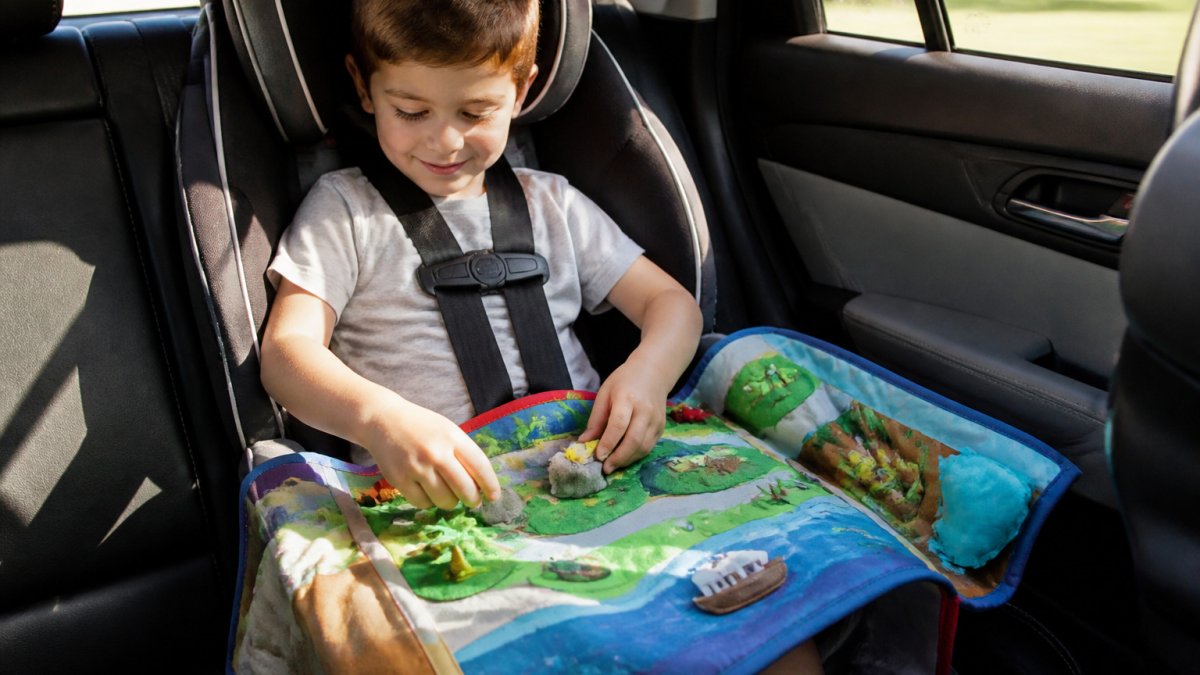
A fold-out play blanket can serve this role. Our Towel-Pal line is designed for beach and pool use.
For longer drives, plan two or three short activities rather than one long one. Our guide on keeping toddlers entertained on long car rides covers practical strategies for the road. Children switch focus more easily when the next activity is already waiting.
How to Judge Safety, Materials and Value Before You Buy
Before buying any screen-free toy, check the age label, the materials, and any small parts. Choking hazards are the most important safety point for children under three, so avoid loose parts that can fit through a toilet paper roll.
Look at materials too. Read the product listing for the exact fabric before you buy, and wash items according to the care instructions.
On value, compare the cost per use over time. Many parents find that rotating a few toys every couple of weeks keeps the set feeling new without buying more.
Consumer Product Safety Commission toy safety guidance
Choosing Your First Screen-Free Toy This Week
Start with the child's age and the situation you need to cover, whether that is home, the car, or a restaurant. Then pick one item that is compact, age-appropriate, and easy to start alone.
A fold-out play blanket is a practical starting point for many families. If your toddler plays rough, see these durable play blankets for rough toddlers. You can browse our full range of Towel-Pal designs to find a theme your child will enjoy.
Shop all BlanketPals products and bring one screen-free option into your next trip or quiet afternoon.
Frequently Asked Questions
What are the best screen-free toys for kids?
The best screen-free toys depend on age and setting, but the most reliable picks are open-ended items such as building sets, drawing materials, puzzles and playscapes that children can use in several ways. For a versatile option, the BlanketPals Towel-Pal range turns a single item into a 3D play surface with a racetrack, coral reef or quarry print, and each towel is 37 by 22 inches (59 by 35 cm), with the exact fabric listed on each product page. Look for toys that reward repeated use rather than a single fixed outcome.
What toys keep kids busy without screens?
Toys that keep kids busy tend to offer a clear starting point and room to change the play. Vehicles on a printed track, pretend-play sets and sticker or drawing activities usually hold attention for longer than single-function toys. Expect a child to lose interest in one toy after a few days, so rotating a small set of toys often keeps play going better than buying more toys at once.
How can I encourage my child to play independently?
Start with a short, set-up play area that the child can see and reach, then step back for 10 to 15 minutes while you stay nearby. Toys with a clear beginning and no required adult input, such as a racetrack playscape or a kit with pieces stored in one place, help children start on their own. Praise the play itself rather than the result, and extend the time gradually as confidence grows.
Are screen-free toys good for child development?
Hands-on toys support fine motor skills, imaginative play and problem-solving, which are central to how young children learn. Open-ended play where the child decides the rules tends to build these skills more than toys that do everything for them. Choose toys that match the child's current stage and check that small parts are kept away from children under three, since choking hazards are a common safety concern.
