


Quick Summary
Kids lose interest in toys quickly because play stops feeling new, challenging, or connected to what they currently care about. Repetition dulls curiosity, development shifts what feels fun, and competing options pull attention away. The toy itself is often fine; the child has moved on.
- Repetition dulls curiosity once a child has explored every feature of a toy.
- Interest follows developmental stages, so a toy that worked at one age can feel flat at the next.
- Storing some toys and rotating them every two weeks makes old favorites feel new again.
- Open-ended items like blankets keep play going because the child decides what they become.
- A broad, persistent drop in play across all activities is worth discussing with a pediatrician.
Table of Contents
- Why Do Kids Lose Interest in Toys So Quickly?
- Why Kids Lose Interest in Toys: The Short Answer
-
When Children Typically Lose Interest in Toys, by Age
- Toddlers (roughly 1 to 3): Novelty Wears Off Fast
- Preschoolers (roughly 3 to 5): Imagination Outruns the Toy
- Early Primary School (roughly 5 to 8): Rules, Collections, and Mastery
- Later Primary School (roughly 8 to 11): Peers and Hobbies Take Over
- Early Adolescence (roughly 11 to 13): Play Doesn't Disappear, It Changes Form
- Too Many Toys and the Problem of Novelty
- Toy Rotation Ideas That Bring Old Favorites Back to Life
- How to Encourage Independent Play Once Interest Fades
- Open-Ended Play Ideas That Keep Kids Engaged Longer
- When a Lack of Interest Deserves a Closer Look
- Choosing Play Products That Hold Attention Longer
- Frequently Asked Questions
Why Do Kids Lose Interest in Toys So Quickly?
Last Updated: November 2, 2026
Kids lose interest in toys faster than most parents expect, and it is rarely because the toy was bad. Novelty wears off, children grow, and the toy stops matching what they want to do next.
Parents often ask whether a single blanket can hold attention for more than a few days. The honest answer is that interest depends on the child, the play environment, and how often the toy is refreshed.
Why Kids Lose Interest in Toys: The Short Answer
Children lose interest in toys when the play stops feeling new, challenging, or connected to their current interests. A toy that once felt like an adventure becomes predictable once the child has explored every feature.
Three factors drive most of the drop-off: repetition, developmental change, and competing options. Repetition dulls curiosity quickly. Development shifts what a child finds fun. And once a more exciting option appears, the old favorite gets pushed aside.
When Children Typically Lose Interest in Toys, by Age
Interest in toys follows developmental stages, and the timing varies from child to child. Some children move on within days, while others play with the same items for months. Looking at age patterns helps you set realistic expectations, and it also shows why a toy that worked at one stage can feel flat at the next.
Toddlers (roughly 1 to 3): Novelty Wears Off Fast
Toddlers are driven by discovery, so a toy often holds attention only until they have worked out how it behaves. Once the mechanics are understood, a toddler may simply drift to the next object on the floor.
For this age group, flexible play works better than fixed-purpose toys. A blanket that can become a hill, a hideout, or a racetrack gives a toddler new ways to explore without buying something new each week.
Preschoolers (roughly 3 to 5): Imagination Outruns the Toy
Preschoolers start assigning roles and stories to objects, so a toy's appeal depends less on its features and more on what the child can pretend it is.
A common pattern at this stage is that interest shifts from the toy itself to the story around it. If a child stops playing with a toy set, the fix is often to add a character, a setting, or a simple prompt rather than to replace the set.
Early Primary School (roughly 5 to 8): Rules, Collections, and Mastery
Children in this band often become attached to toys that let them build, collect, or master a skill, construction sets, trading cards, simple games with clear rules. Interest can drop sharply when a toy becomes too easy, because the challenge was the point.
The practical takeaway is that this age group responds well to toys that scale with them. A building set that can be rebuilt at a higher level, or a game with a few rule variations, tends to stay in rotation longer than a toy with a single fixed challenge.
Later Primary School (roughly 8 to 11): Peers and Hobbies Take Over
As children get older, their attention turns toward friends, hobbies, and screens. Peer influence matters a great deal here. If classmates have moved on from a certain kind of toy, a child may stop wanting it even when they still enjoy it privately.
Digital entertainment adds another pull. Screens offer fast rewards and constant novelty, which can make hands-on toys seem slow by comparison.
Early Adolescence (roughly 11 to 13): Play Doesn't Disappear, It Changes Form
The transition from childhood to adolescence is often described as the point where toys are abandoned, but that framing is too simple. Many young teens still play, they just stop calling it that.
Watch out: treating every dropped toy as a problem can push a child away from play altogether.
Across all of these stages, the through-line is the same: interest tracks the child's developing skills, social world, and sense of challenge.
Too Many Toys and the Problem of Novelty
A large toy collection can work against engagement. When every toy is always visible, children have so many choices that none of them feels special. Attention scatters across the room, and playtime turns into sorting rather than playing.
Fewer toys available at one time often produces deeper play. When a favorite comes back after a break, it feels new again. This is one of the simplest ways to reduce boredom without spending more money.
A few numbers and ideas from this section make the reasoning easy to scan:
| Approach | How it works | Main benefit |
|---|---|---|
| Fewer toys out at once | Fewer choices on display | Deeper play, less scattered attention |
| Two-bin rotation | Swap bins every two weeks | Old favorites feel new again |
| Theme rotation | One theme out at a time | Focused, predictable reveals |
| Blanket reinvention | Same blanket, different uses | Saves money, keeps play fresh |
Toy Rotation Ideas That Bring Old Favorites Back to Life
Toy rotation means storing some items and swapping them in every week or two. For fresh ways to reuse existing blankets, see creative ways to use blankets for indoor forts. It keeps the collection feeling fresh while cutting down on clutter. Here are a few practical approaches:
- Two-bin rotation: Keep one bin in use and another stored. Swap them every two weeks.
- Theme rotation: Group toys by theme, such as ocean, vehicles, or building, and bring out one theme at a time.
- Blanket reinvention: Use the same blanket in different ways, as a picnic cloth one week and a fort the next.
Rotation works best when you keep the storage consistent and the swaps predictable, so the reveal of an old toy feels like an event.
How to Encourage Independent Play Once Interest Fades
When a child stops engaging with a toy, the fix is often a small change in how the play is set up, not a new purchase. You can also try blanket play ideas that children can start on their own. Try these steps:
- Change the setting. Move the toy to a different room, or build a small corner around it.
- Add a simple prompt. A single object, such as a toy car on a blanket hill, can spark a story.
- Step back. Let the child lead. Independent play grows when adults stop directing every move.
- Sit nearby, not in charge. Your presence can make a child feel safe enough to explore alone.
Expect independent play to build gradually. Short sessions that end on a good note tend to lead to longer ones over time.
Open-Ended Play Ideas That Keep Kids Engaged Longer
Open-ended toys and materials stay interesting because the child decides what they become. A plain blanket, a few pillows, and some household objects can turn into a ship, a cave, or a shop.
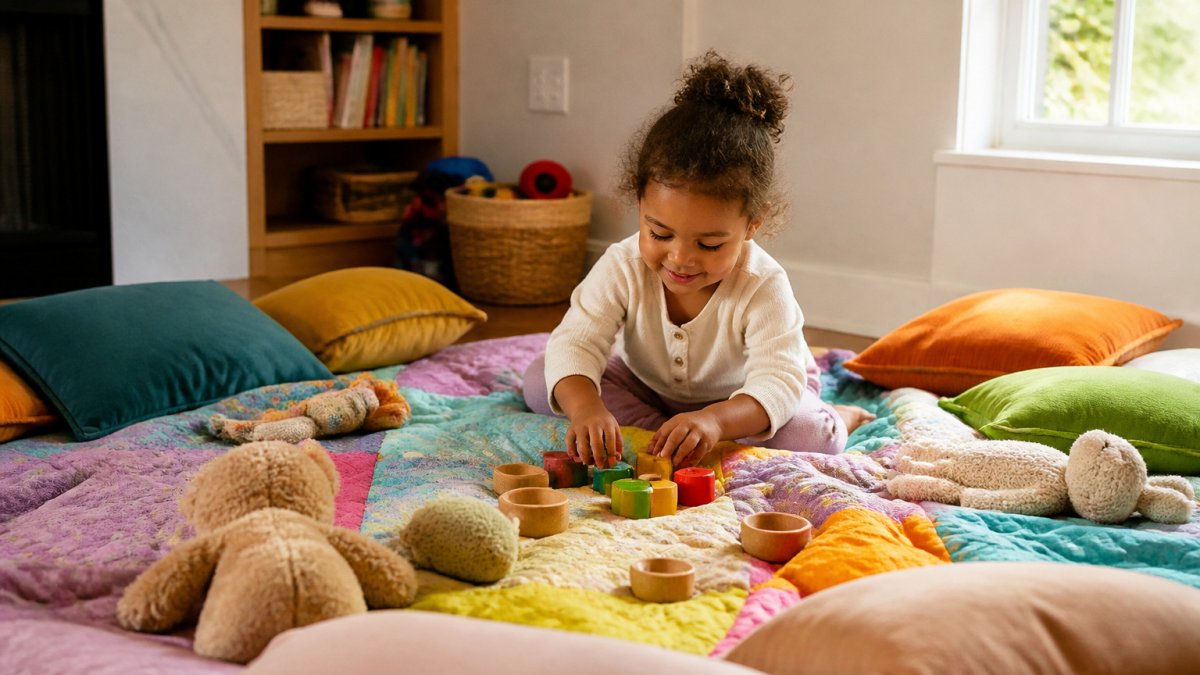
Good open-ended options include blankets that can be shaped into different spaces, building materials, and simple props like cups or scarves. For more ideas, see open-ended play ideas for toddlers.
When a Lack of Interest Deserves a Closer Look
Most loss of interest is ordinary and temporary. A useful approach is to separate the ordinary range of play behavior from the patterns that are worth raising with a clinician, without trying to diagnose anything from a single observation.
What Ordinary Variation Looks Like
A common pattern is that children cycle through intense interests and quiet periods. A child may ignore toys for a week and then return to them with fresh energy.
Interest can also dip for reasons that have nothing to do with development, a new sibling, a move, a change in routine, a stretch of illness, or a busy school term. When the dip lines up with a life change, it usually settles as the change does.
Patterns Worth Raising With a Professional
The distinction that matters is between a child who has shifted interests and a child who has broadly withdrawn from play and activity. The following patterns are generally worth discussing with a pediatrician or child development professional:
- A sustained drop in curiosity across nearly all activities, not just toys, lasting several weeks or more.
- Loss of interest in play that the child previously loved, combined with withdrawal from friends or family.
- A child who seems unable to sustain play with any object or activity, or who appears distressed during play.
- A regression in skills the child had already mastered, such as language, motor skills, or self-care.
- Sleep, appetite, or mood changes that accompany the drop in interest.
Watch out: a single quiet afternoon or a preference for screens over toys is not, by itself, a red flag. The concern is a broad and persistent pattern, not one data point.
How to Gather Useful Information Before You Ask
If you do decide to raise the question, a short written record helps. Note what the child used to enjoy, what they now choose instead, how long the change has lasted, and whether it coincided with any life event.
Reaching out early is a reasonable step, not an overreaction. The goal is not to label a child but to get a clearer picture of whether the pattern reflects normal variation in temperament and interests or needs further attention.
Choosing Play Products That Hold Attention Longer
When shopping for new play products, look for items that adapt as your child develops. Browse screen-free toys sorted by age and situation to find options that hold a child's attention. Versatility matters more than any single feature.
BlanketPals designs its 3D playscapes around this idea. The Pinch, Pull & Drop kerchief design lets children reshape the blanket into new scenes, and sizes ranging from Toddler to Twin XL suit different ages.
Frequently Asked Questions
Is it normal for toddlers to lose interest in toys quickly?
Yes. Toddlers switch activities often because they are constantly testing new skills and looking for novelty. A toy that was exciting on Monday may be ignored by Friday, and this is a normal part of early development. Short attention spans at this age usually reflect curiosity rather than a problem. If you rotate toys, offer a few options at a time, and let your child lead the play, most toddlers will return to favorites over time. Persistent disinterest in all play, or a lack of any engagement with people, is a different situation worth discussing with your pediatrician.
Can having too many toys make kids less interested in them?
It can. When a child has a large selection, toys compete for attention and none gets explored deeply. Children often flit between items instead of building focused play. Keeping a smaller set accessible and storing the rest lets each toy feel new again when it returns. Toy rotation is one practical way to do this: swap a portion of toys every few weeks so familiar items reappear as fresh options.
How can I encourage my child to play independently?
Start with short independent sessions of five to ten minutes while you stay nearby, then gradually increase the time. Set up a play space with a few open-ended materials, such as blankets, blocks, or containers, and avoid stepping in to direct the play. Praise the child's ideas rather than the outcome. Many children engage more readily when a parent sits nearby doing a quiet task. Consistency matters more than perfect setups, so a predictable daily play window often works better than occasional long sessions.
When should I be concerned about a child's lack of interest in play?
Losing interest in one toy is common, but a broad lack of interest in play, combined with regression in skills the child already had, withdrawal from family members, or loss of interest in people, warrants a conversation with your pediatrician. Early guidance is useful because it can clarify whether the pattern is typical variation in temperament and interest or something that needs assessment. Trust your instincts and bring specific examples, such as what the child used to enjoy and when the change began.
