


Quick Summary
An interactive play mat gives your baby a soft, safe place to move, look, and reach, with padding, hanging toys, and contrasting textures. Choose one that matches your baby's current developmental stage, pick foam or fabric to suit your floor, and check the size and safety features before you buy.
- Match the mat's features to your baby's current milestone, not a future one.
- Foam mats are firmer and hold shape; fabric mats are softer and fold more easily.
- Choose a mat large enough that your baby cannot easily roll off the edge.
- Tug every hanging toy and attachment firmly before first use and recheck it weekly.
- Remove or shorten any string or cord longer than about 7 inches near the play area.
Table of Contents
- What an Interactive Play Mat Actually Does for Your Baby
- Start With Your Baby's Developmental Stage
- Foam Play Mat vs Fabric Play Mat: Which Suits Your Home
- Choosing the Right Baby Play Mat Size
- Best Baby Play Mat for Tummy Time: What to Look For
- Baby Play Gym With Arch and Activity Gym Features
- Your Safety Checklist Before You Buy an Interactive Play Mat
- Choosing Your Play Mat and Setting It Up at Home
- Frequently Asked Questions
What an Interactive Play Mat Actually Does for Your Baby
Last Updated: November 4, 2026
An interactive play mat gives your baby a safe, soft place to move, look, and reach.
The core idea is simple. Your baby learns by looking, touching, and trying. A play mat puts interesting things within reach so those early moves feel rewarding.
Here is what a well-chosen interactive play mat generally offers:
- A soft surface for floor time and tummy time
- Hanging or attached toys that invite reaching and grasping
- Contrasting colors and textures that hold a young baby's attention
- Sound or light features that reward movement, in some models
- A defined play space that keeps your baby in one safe zone
Many parents wonder whether a mat is worth the space it takes. The answer depends on how your baby plays and how much floor time you want to give them.
This guide walks you through the choices that matter most. We cover developmental stage, material, size, tummy time features, safety checks, and setup at home.
Start With Your Baby's Developmental Stage
The best interactive play mat is the one that matches where your baby is right now. A newborn and a six-month-old need very different things from the same mat.
Use this milestone-to-feature map as your starting point:
- Visual tracking (roughly 0-3 months): Your baby is learning to follow high-contrast patterns and faces. Look for a mat with black-and-white or bold geometric designs, a safe mirror, and hanging toys positioned about 8-12 inches above the chest, close enough to focus on, far enough to encourage reaching later.
- Head control and tummy time (roughly 2-4 months): Your baby is lifting their head and pushing up. Choose a firmer foam base that does not sink under their weight, and place toys to the sides rather than directly overhead so they turn their head to look.
- Reaching and grasping (roughly 3-5 months): Your baby is swatting and grabbing. Look for adjustable or removable hanging toys, crinkly textures, and lightweight rattles they can bat at. Toys that are too high or too heavy frustrate this stage.
- Rolling (roughly 4-6 months): Your baby is rolling both ways. A larger mat with a defined edge and a low profile helps here, since a small mat leaves them near the edge. Remove overhead arches that could be bumped during rolls.
- Sitting (roughly 6-9 months): Your baby is sitting with support and then independently. A mat with a slightly textured, non-slip surface and a bit more cushioning supports sitting play, and detachable toys can be moved to the floor for seated reaching.
A common mistake is buying a mat for a skill your baby hasn't reached yet.
Watch out: if your baby is late to roll or sit, a mat with too much cushioning or a domed surface can make those movements harder to practice.
The article maps each developmental stage to the mat features that suit it, so this table gives a quick scan of that guidance. For more practical play ideas suited to each age, see open-ended play ideas for toddlers.
| Stage | Typical age | Mat feature to look for |
|---|---|---|
| Visual tracking | 0-3 months | High-contrast patterns and toys 8-12 inches above chest |
| Head control and tummy time | 2-4 months | Firmer base, toys placed to the sides |
| Reaching and grasping | 3-5 months | Adjustable or removable hanging toys, crinkly textures |
| Rolling | 4-6 months | Larger mat with defined edge and low profile |
| Sitting | 6-9 months | Slightly textured non-slip surface and more cushioning |
Foam Play Mat vs Fabric Play Mat: Which Suits Your Home
Foam and fabric mats differ mainly in firmness, cleaning, and how much cushioning they give. Foam mats are usually firmer and hold their shape, which helps babies push up during tummy time. To see how well different mat and blanket materials hold up to rough use, check out durable play blankets tested for rough toddlers. Fabric-covered mats feel softer and can be easier to fold and store.
Think about your home first:
- Hard floors: A thicker foam mat adds cushioning and warmth.
- Carpet: A thinner fabric mat may be enough.
- Frequent spills or messes: Choose a wipeable surface.
- Limited storage: A foldable fabric mat takes less room.
Watch out: a very soft mat can make it harder for some babies to push up during tummy time. If your baby struggles to lift their head, try a firmer surface for those sessions.
Choosing the Right Baby Play Mat Size
Size matters more than many parents expect. A mat that is too small leaves your baby near the edge, where they can roll off.
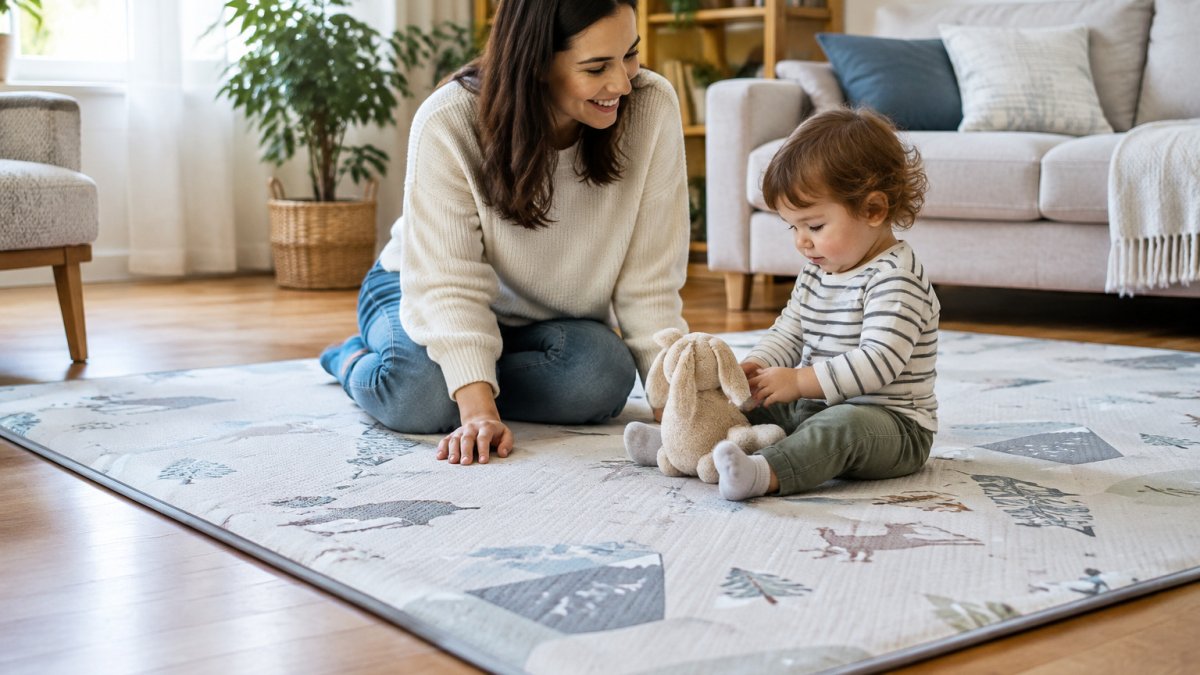
Measure the floor space you can give up, then compare it to the mat's footprint.
!A parent kneeling on a soft play mat in a bright living room while a toddler plays on it with a soft toy, showing the mat's footprint against the floor
If you plan to use the mat for several years, choose a size that still fits when your child is crawling or walking.
Best Baby Play Mat for Tummy Time: What to Look For
Tummy time builds neck, shoulder, and core strength. A good tummy time mat should feel firm enough to push against and soft enough to be comfortable. Look for these features:
- A supportive base that does not sink under your baby's weight
- A low, gentle slope or flat surface
- Toys placed to the sides, so your baby can look at them while lying on their belly
- A removable or folding design if you want to move it between rooms
Short sessions work best. Start with a few minutes a few times a day, then increase as your baby gets stronger.
Baby Play Gym With Arch and Activity Gym Features
A baby play gym with an arch is a common type of interactive mat. The arch holds hanging toys over your baby's chest and face, giving them something to reach for while lying on their back.
When you compare arch gyms with flat play mats, consider:
- Arch height: Lower arches suit younger babies, while higher ones let older babies reach.
- Toy attachment: Clip-on toys can be swapped out, which keeps play fresh.
- Stability: A sturdy frame stays put when your baby kicks or swats.
- Space: Arch gyms take more room than a simple flat mat.
For a practical check, lie on the mat yourself. If the toys hang within easy reach of a lying adult's hands, they are probably at a good height for a young baby to look at.
Your Safety Checklist Before You Buy an Interactive Play Mat
Safety should come first, and a vague promise that a mat is "safe" is not enough. Use this checklist before you buy or set up any mat, and verify each item against the product packaging, listing, or manual rather than relying on marketing language.
- **Look for a recognized safety certification or standard label, and check the manufacturer's documentation for the specific standards the product meets.
- Check for small parts that could detach. Hanging toys, clips, mirrors, and rattles should be securely attached and should not fit inside a small-parts cylinder (the choke-test gauge used for children under three). Tug each attachment firmly before first use and recheck it weekly.
- Inspect cords, strings, and ribbons. Long cords can wrap around a baby's neck. Remove or shorten any string longer than about 7 inches, and avoid mats with dangling cords near the sleep or play area. Never tie toys to the crib or playpen with string.
- Confirm non-toxic materials. Check the product documentation for any statements about the materials used and whether they meet recognized low-emission or chemical-safety standards. New foam can off-gas; air the mat out for a few days before use if it has a strong smell.
- Verify the frame and arch are stable. A play gym arch should not tip when a baby kicks or pulls. Check that the base is wide enough and that joints lock securely.
- Check the surface for entrapment and pinch points. Folding mats should not have gaps that could trap fingers or limbs, and hinges should be covered.
- Plan for supervision at all times. A play mat is not a substitute for adult attention, even when your baby seems content. Never leave a baby unattended on a mat placed on a raised surface, and keep the mat away from stairs, heaters, windows, and blind cords.
Watch out: a mat that passes a visual check can still have a loose clip or a frayed seam after a few weeks of use. Build a quick weekly inspection into your routine, tug the toys, check the seams, and look for cracks in foam or peeling laminate.
Choosing Your Play Mat and Setting It Up at Home
Once you've picked a mat, placement is the next step. Put it in a room with good natural light and a clear floor. Keep it away from stairs, sharp furniture corners, and heat sources.
Many parents set up the mat in a living room where they spend the day. For more ideas, see creative ways to use blankets for indoor forts.
Here is a simple setup routine:
- Clear the area of hazards
- Lay the mat flat and check that it sits level
- Attach toys at a height suited to your baby's current stage
- Place a favorite soft toy or blanket nearby to encourage exploration
- Check the setup each day for wear, loose parts, or dirt
If your baby loses interest after a week, rotate the toys or move the mat to a new spot. You can compare screen-free toy picks by age and situation to find ones that work well alongside the mat.
Frequently Asked Questions
Which is better for my baby, a foam play mat or a fabric play mat?
Foam mats give firmer, more even cushioning and are easy to wipe clean, which suits tummy time and crawling on hard floors. Fabric mats feel softer, fold more easily and are simpler to pack for travel, but they can absorb spills and need regular washing. Check the washing instructions and whether the cover is removable before deciding. If your baby is still learning to lift their head, a firmer foam base often gives more stable support, while a plush fabric surface may suit a calmer nap or sitting area.
What size should a baby play mat be?
Choose a mat large enough for your baby to roll, reach and stretch arms and legs without touching the edges, and big enough to hold any arch or activity gym you plan to add. Measure the floor space in your main play area first, then check the mat's dimensions in centimetres. Larger mats give room for crawling as your baby grows, while smaller folding mats are easier to store and move between rooms. Make sure there is clear space around the mat for supervised play.
Are interactive play mats safe for babies?
Look for mats that state compliance with recognised toy and children's product safety standards, and check the label or manufacturer documentation for the age range. Inspect hanging toys, cords and ties regularly, and remove any loose parts that could be swallowed. Never leave a baby unattended on a play mat, and keep the area free of cords or objects that could pose a choking or strangulation risk. Always follow the manufacturer's instructions for setup and use.
How do you clean and maintain a baby play mat?
Check the care label first. Many fabric covers can be spot-cleaned or machine-washed on a gentle cycle, while foam mats usually wipe clean with mild soap and water. Let the mat air dry fully before using it again to prevent mould. Wash or wipe detachable toys regularly, and inspect seams and attachments for wear. Replace the mat if the foam crumbles or the cover tears, since damaged surfaces are harder to keep hygienic and may no longer offer safe support.
