


Last Updated: November 10, 2026
Quick Summary
Personalized blankets work for both play and sleep because a name or printed scene makes a child feel ownership, which encourages repeat use. Choose a playscape print in fleece for floor play, or a softer face and smaller size for bedtime. Check the care label first, since hand-wash or line-dry-only blankets get used less.
- A name on a blanket helps a child feel ownership and encourages repeat use.
- Drape a fort over two chairs and a table, weigh corners with cushions, leave one side open.
- Read the care label before buying; hand-wash or line-dry-only blankets get used less.
- Wash warm unless the label allows hot, tumble dry low, and skip fabric softener.
- Match size to main use: Toddler for naps, Throw for forts, Twin XL for beds.
Table of Contents
- Why Personalized Blankets Work for Play and Sleep
- Kids Blankets for Indoor Forts and Play
- Soft Washable Blankets for Children: Materials and Care
- Personalized Blankets for Kids with Names
- Personalized Kids Blankets with Pictures
- Choosing the Right Size for Sleep, Play, and Travel
- Blanket Safety by Age and Everyday Durability
- Picking Your Child's First BlanketPal
- Frequently Asked Questions
Why Personalized Blankets Work for Play and Sleep
A personalized blanket earns its place in a child's day because it does two jobs at once: it signals comfort at nap time, and it becomes a prop for imaginative play the rest of the day. A blanket a child recognizes as theirs tends to get used far more than one pulled from a linen cupboard.
The name or picture on the fabric matters more than it looks. Many parents find that a name on a blanket helps a child feel ownership over it, which can encourage the repeat use parents want.
Below, we'll walk through how to choose one: the play features worth paying for, the fabrics that survive real childhoods, sizing across sleep and travel, and the safety details that change by age. Most guides skip the last two. That's where the returns are.
Kids Blankets for Indoor Forts and Play
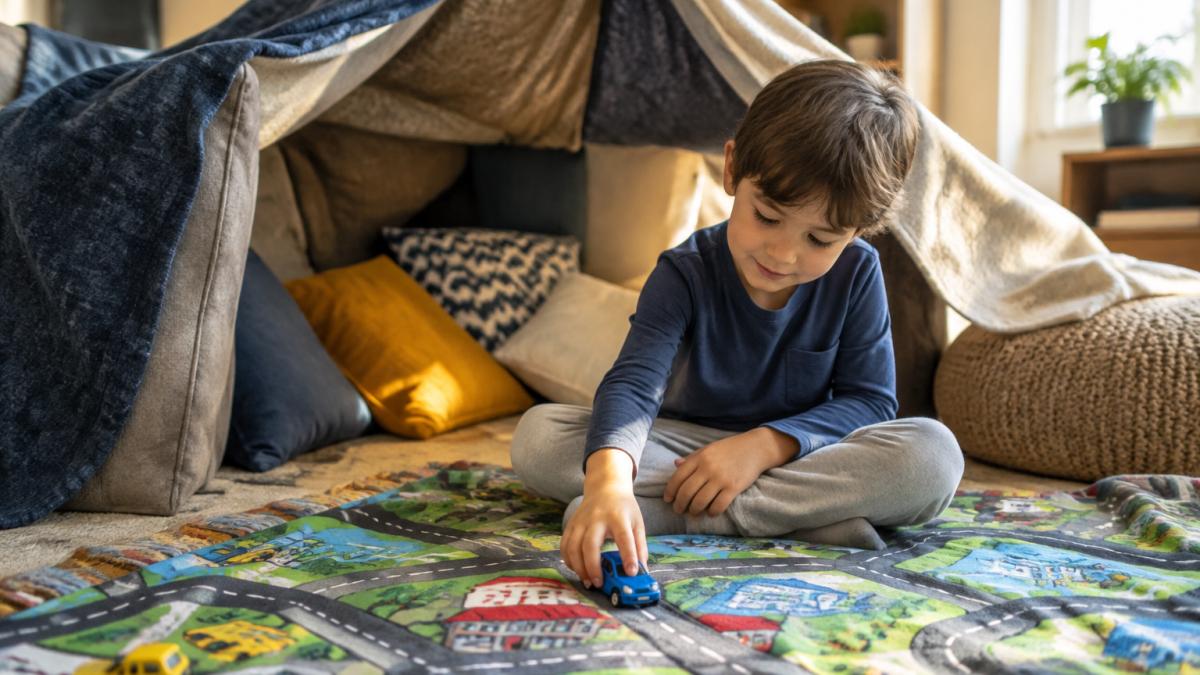
A blanket with a printed scene a child can drive toys across gives play a starting point, which can help kids spend more time playing.
A common mistake is buying a large, thin throw for fort building. It drapes well but slides off furniture and offers no surface for toys. A blanket with enough structure to hold a shape and a dense pattern can help kids invent stories.
Turning a Blanket into a Fort, Track, or Playscape
Three setups cover most of what kids actually do with a blanket indoors:
- The fort: drape over two chairs and a table, weigh the corners with cushions, leave one side open for entry.
- The track: lay the blanket flat and use the printed roads, runways, or trails as a course for toy cars and figures.
- The playscape: fold the blanket over a mattress or floor cushion to make hills, tunnels, and hiding spots for small toys.
If you want more starting points, our guide to creative ways to use blankets for indoor forts has step-by-step builds, and blanket play ideas that beat screen time covers games that keep a blanket in rotation for longer than a week.
Soft Washable Blankets for Children: Materials and Care
Softness is the first thing parents test and the last thing that should decide the purchase. Washability matters more, because a blanket that can't take a hot cycle and a tumble dry ends up in the cupboard by month two. The practical test is simple: read the care label before you buy, and if it says hand wash or line dry only, assume the blanket will be used less than you expect.
Look for a smooth face fabric that doesn't pill after repeated washing. Pilling is caused by short fibers working loose and tangling into little balls; it shows up fastest on cheap polyester fleece and on loosely woven cotton. A tight knit or a brushed fleece with a dense pile resists it better. Check the care label for a recognized textile safety certification. OEKO-TEX standards for harmful substances in textiles explains what the certification covers: it tests for harmful substances in the finished article, but it does not certify that a blanket is safe for infant sleep, flame-resistant, or hypoallergenic. Those are separate claims, and a certification logo alone shouldn't be read as any of them.
Fleece, Cotton, and Sherpa Compared
Each fabric suits a different job, and the trade-offs are concrete:
- Fleece is commonly used for play blankets. A dense pile can resist pilling, and fleece dries quickly. The downside is that low-quality fleece can feel clammy and traps heat, so it's a poor choice for a warm room or a child who runs hot.
- Cotton breathes best and suits warmer rooms and summer naps. It wrinkles and takes longer to dry, and a thin cotton blanket offers little cushioning on a hard floor. A cotton muslin is breathable but too thin for fort building.
- Sherpa is the softest against skin and the warmest, which makes it a bedtime favorite, but it sheds and needs gentler washing. Sherpa pile can mat down after repeated hot washes, so treat it as a bedtime blanket rather than a floor blanket.
Washing and Durability Guidance
A few concrete habits extend a child's blanket far beyond the first month:
- Wash warm, not hot, unless the label allows hot. Hot water shrinks cotton and can break down fleece pile. A warm cycle with a gentle detergent is enough for most everyday soiling.
- Tumble dry low. High heat is the fastest way to pill fleece and shrink cotton. If the label allows machine drying, use low heat and remove the blanket while it's still slightly damp.
- Skip fabric softener. It coats fibers and reduces absorbency, and on fleece it can make the pile feel greasy.
- Wash before first use. New blankets carry sizing and manufacturing residue that can irritate sensitive skin.
- Inspect after every wash. Check the binding, the print edges, and any loose threads. A blanket that is breaking down at the surface is a sign to retire it, especially for under-threes.
Durability comes down to three things: stitching at the edges, print adhesion, and fabric weight. Check the binding on the hem, since that's where blankets fail first. A heavier fabric resists tearing when it's dragged across floors, and a print that's part of the fabric rather than a coating survives washing.
Personalized Blankets for Kids with Names
Name personalization is the single biggest driver of attachment, and it's the detail that turns a blanket into a gift.
Watch out: check spelling twice before ordering.
The same logic applies to durable play blankets for rough toddlers if you're buying for a child who drags, tugs, and chews.
Personalized Kids Blankets with Pictures
A printed picture does something a name can't: it gives the child a world to play in. A blanket printed with a racetrack, an airport, or a beach scene becomes a toy in its own right, and that's the version kids reach for during downtime rather than just at bedtime.
When choosing a picture, pick a scene with multiple entry points. A single large image gets old fast; a detailed scene with roads, buildings, and landmarks lets a child invent a new story each time.
Choosing the Right Size for Sleep, Play, and Travel
Size is where most blanket purchases go wrong, because parents buy for one use and the blanket gets used for three. Match the size to the job the blanket will do most, then accept the compromise on the others.
| Size | Best for | Play surface | Travel |
|---|---|---|---|
| Toddler | Nap time, stroller, car seat | Small, one child | Folds into a bag easily |
| Throw | Floor play, forts, one child | Good for toy play | Rolls up, fits in a backpack |
| Twin XL | Bed use, older children | Large, room for two kids | Stays home |
For travel, a smaller blanket that folds flat is easier to pack. Our guide to packing light for family trips covers how to fit a child's blanket into hand luggage, and keeping toddlers entertained on long car rides has ideas for using a blanket during the drive itself.
Blanket Safety by Age and Everyday Durability
Safety guidance changes with age. Supervised play and unsupervised sleep call for different approaches, and parents should follow their pediatrician's guidance.
Durability and Inspection
Durability comes down to three things: stitching at the edges, print adhesion, and fabric weight. Check the binding on the hem, since that's where blankets fail first. A heavier fabric resists tearing when it's dragged across floors, and a print that's part of the fabric rather than a coating survives washing.
Inspect the blanket after washing and retire it if the surface starts to break down.
For a child who is hard on belongings, our tested picks for durable play blankets for rough toddlers go deeper on construction.
Picking Your Child's First BlanketPal
Start with the use case, not the design. If the blanket will mostly be on the floor, pick a playscape print in fleece. If it's for bedtime, pick a softer face and a smaller size. If it's a gift, name personalization plus a detailed scene covers both bases.
BlanketPals blankets transform ordinary blankets into 3D playscapes with our Pinch, Pull & Drop kerchiefs that kids can interact with, available in Toddler, Throw, and Twin XL sizes, with water-resistant options for picnics. They are portable and easy to fold.
If you're buying for the beach or pool, our Towel-Pal at Coral Bay Beach pairs a fleece front with a cotton back and comes with a Booster, and the Towel-Pal at the Race Track gives car-obsessed kids a printed track to play on before they dry off.
The hardest part isn't finding a blanket. It's finding one that survives a toddler, keeps a seven-year-old interested, and still gets used at bedtime six months later. That's the problem BlanketPals set out to solve, with 3D playscapes kids can drive toys across, Pinch, Pull & Drop kerchiefs that add a hands-on element, and sizes from Toddler to Twin XL that fold flat for travel. Get started with BlanketPals and give your child a blanket that works as hard at playtime as it does at nap time.
Frequently Asked Questions
What should I look for in a personalized blanket for a child?
Start with the material and the wash label, then look at the personalization method. Check the size against your child's age: a small blanket suits a toddler's lap and travel bag, while a larger one covers a bed. If the blanket doubles as a play surface, a printed scene can give kids something to play with.
Are personalized blankets safe for babies and toddlers?
Follow your pediatrician's safe-sleep guidance for babies and toddlers. Wash new blankets before first use and inspect seams after each wash.
How do you wash a personalized kids' blanket?
Check the care label before washing, and follow its instructions for the fabric and print.
Can children use blankets to build indoor forts?
Yes, a large blanket can drape over chairs to form a fort. Pair it with cushions to help it stay in place, and fold it up afterward for storage.
